As I write this, it was a bit over a month ago that I was back in Cornwall on a second holiday visit (our first being cut short by the untimely death of my uncle, whose funeral we returned for). I only realised when leaving that William Hennah rested very near to where we stayed and, naturally, I wanted to go and see him.
Who Was William Hennah?
For those of you less immersed in the Napoleonic Wars than me, William Hennah (at the time a Lieutenant, not Captain) is best known (and thus is known to me) by his involvement in the Battle of Trafalgar on October 21st, 1805. He was the First Lieutenant of HMS Mars under Captain George Duff, a 74-gun third-rate ship of the line serving under Vice-Admiral Collingwood’s Squadron. The Mars took heavy fire in the battle and sustained serious damage, including the loss of 29 souls, and 69 wounded. Among the dead lay her captain, his head taken clean off his shoulders by a cannonball not long after battle was joined, and upon whose loss command fell to William Hennah. George Duff’s body was paraded around the decks to the sound of cheering in what seems to modern sensibilities perhaps a little peculiar, but the men’s morale was not broken by the death of their beloved captain, and this was their display of it to the enemy. His body was draped in British colours shortly after, and the battle commenced in full.
Hennah commanded ably, directing the crew of Mars to fire, despite herself being almost crippled, into the Fougueux. His ability at Trafalgar earned his men’s gratitude and respect and compelled them to a rare display, even of the time, in gracing him with a Letter of Commendation from the ship’s company. He was the recipient of Thanks from Parliament on his return to England too, and promoted Captain for his service.
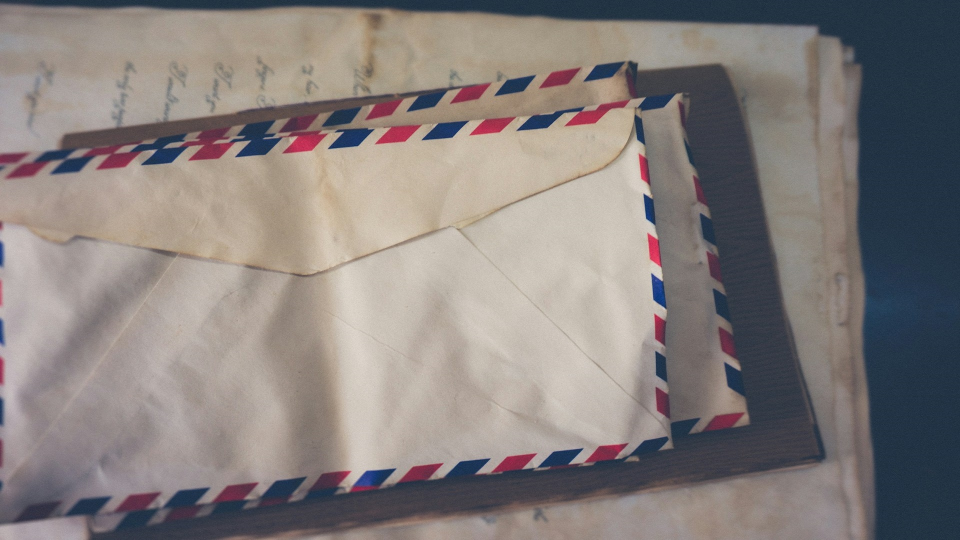
I first discovered Hennah from a beautiful letter penned to Captain Duff’s wife, which I would like to reproduce here in full. I think it so noble, yet clearly so pained, as he tries to navigate the most difficult task of explaining to a wife the death of her dear husband. It is this impression of Hennah that makes me feel so fond of him. His brave and able command, balanced by his tenderness here, portrays a complex and good man. It struck me from the first moment I read it.


Madam,
I believe that a more unpleasant task, than what is now imposed upon me, can scarcely fall to the lot of a person, whose feelings are not more immediately connected by the nearer ties of kindred, but from a sense of duty, (as first Lieutenant of the Mars,) as being myself the husband of a beloved partner, and the father of children; out of the pure respect and esteem to the memory of our late gallant Captain, I should consider myself guilty of a base neglect, should you only be informed of the melancholy circumstances attending the late glorious, though unfortunate victory to many, by a public gazette. The consequences of such an event, while it may occasion the rejoicings of the nation, will in every instance be attended with the deepest regrets of a few.
Alas! Madam, how unfortunate shall I think myself, should this be the first intimation you may have of the irreparable loss you have met with! what apology can I make for entering on a subject so tender and so fraught with sorrow, but to recommend an humble reliance on this great truth, that the ways of Providence, although sometimes inscrutable, are always for the best.
By this, Madam, you are in all probability acquainted with the purport of my letter. Amongst the number of heroes who fell on that ever-memorable 21st inst. in defence of their King and Country; after gloriously discharging his duty to both; our meritorious and much respected Commander, Captain George Duff, is honourably classed; his fate was instantaneous; and he resigned his soul into the hands of the Almighty without a moment’s pain.
Poor Norwich is very well. Captain Blackwood has taken him on board the Euryalas, with the other young gentlemen that came with him, and their schoolmaster.
The whole of the Captain’s papers and effects are sealed up, and will be kept in a place of security until proper persons are appointed to examine them. Meanwhile, Madam, I beg leave to assure you of my readiness to give you any information, or render you any service in my power.
And am, Madam, with the greatest respect,
Your most obedient and most humble servant,
WILLIAM HENNAH.
Norwich was George Duff’s (and Sophia Duff’s) son, whom the Captain had ordered off the quarterdeck to keep him safe, writing that he was warmed by the thought of seeing his family again after the battle was over. Alas, he never did.
“Dearest Sophia,
I have just time to tell you we are going into Action with the Combined Fleet. I hope and trust in God that we shall all behave as becomes us, and that I may yet have the happiness of taking my beloved wife and children in my arms. Norwich is quite well and happy. I have, however, ordered him off the quarter-deck.
Yours ever, and most truly,
George”
Hennah never served at sea again. It’s not known to me why – whether the horrors of Trafalgar were enough for one life, or whether he simply had another vision for his future. He retired back to Cornwall, where he lived a life like he had previously, somewhat under the sights of historical record. Not much is known to me aside from his interest in local affairs. He lived as a country gentleman until his peaceful death in Tregony, on the 31st of December 1832, aged 69. His death was marked in a local paper thus: “On the 22inst at Tregony, Cornwall, Captain William Hennah CB one of the old school of British sailors, having entered the navy under Wallis, the circumnavigator and finished his active career in the wake of Collingwood at Trafalgar.”


Standing at the Feet of the Dead:
Written to my Diary on the 28th of September, about events on the 27th of September, 2025. Mild edits have been made for flow and readability but as far as possible I have preserved what I wrote.
St. Cuby’s church is a small one. It was actually quite missable the way we came into the place, partly giving it a very local, cosy, and intimate feeling, but on the other hand it seemed an unremarkable place too that betrayed the prestige and heroism of the man who was buried there.
It took us a while to find his grave – originally, I looked for something ornate. He was, after all, a veteran of Trafalgar – served under Nelson and Collingwood. But no such grave existed. I walked about, at first, frantically scanning the worn and faded headstones of the local dead – many of whom were called William and each of which gave me false alarm. I had no success and eventually Googled his grave to see if there was a picture, and after a bit more searching I found a considerably more worn (than in the photo) headstone that, by running my fingers over the faded lettering, I could be certain belonged to Captain William Hennah R. N.
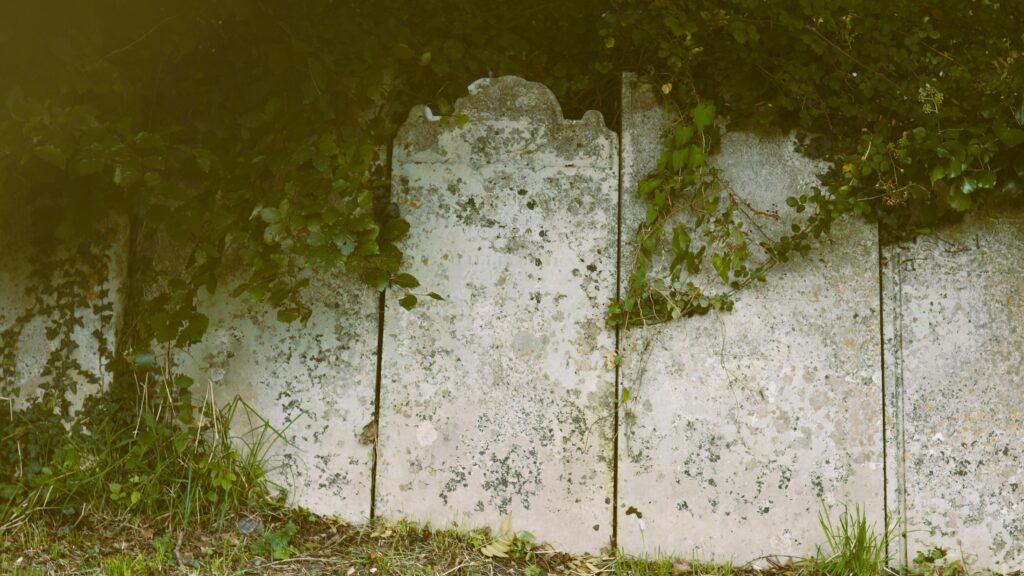
Bugs crawled over his headstone. It had been moved from his resting place (something I hate that the Church do and wish they would not) and leant up against a stone wall aside the church itself. Sap from the trees, and lichen, obscured virtually everything on the headstone except the name ‘William’ and a chalice-like ornament engraved into the top of the stone. Even the bold and distinctive ‘SACRED’ etched at the top was barely visible now.
I said that I don’t suppose he gets many visitors now – that perhaps even many of the locals don’t know who he was. It seemed painfully unfair to me that so great a man could have faded out into obscurity like this. The lack of acknowledgement or ceremony was upsetting. Bugs and insects crawled his headstone like it was just another piece of decaying matter; death left no respect for someone so respectable. I stood alone with him for a moment and cried. My lament was a complex one: in part that England does not make heroes like him anymore and seems likely never to do so again, and in part it was the pain at my own distance from a world I feel to love so much more. I was as close as I could ever be to a man 6ft down and 300 years dead and in a way this was so close but in another, I painfully remained stuck in this fickle, honourless, plastic and mundane world, stood in a cold graveyard dreaming about the dizzying heights of glory those warriors knew off Cape Trafalgar almost 300 years ago. There was a centuries-long silence between my life and his, and this proximity did not close it.
I hope, somehow, that he knew I was there – that I went to see him; that this insignificant person from an insignificant age cared that he once lived.
I struggled very much to keep from crying again, as my sister and I picked the beautiful pink flowers of a wild cyclamen growing in the graveyard, and lay them at his headstone, before I painfully turned away.


Last summer, I visited Portsmouth, and stood aboard the decks of HMS Victory. I stood upon the spot where Admiral Nelson was fatally shot, and sat down in the Orlop deck, in that dark place where he died several hours later. I wept then, as I did while stood as close as I can ever know to be the resting place of William Hennah.
It marks a growing tradition and a deep resolve to visit all of these great men – from the enemy forces as well as our own. Every one of them served with valour, honour, and courage that I find deeply inspiring, and it is in their judgement that I hold myself – not the modern world’s; their legacy that I care to remember – not ours; they, who lived and died for something, not we who live and die for nothing.