Table of Contents
Somewhere between here and there,
Fighting record and reality.
It was a bright cold day in February, and the clocks struck 19. I came back from a local garden centre filled with a familiar feeling of excitement and connection, having bought yet more plants and seeds. I later went upstairs and began to fill out a database I keep in Obsidian, recording what plants I owned, where they were, and other details about them – and I hit that same old friction that had jilted this project from the start. Reality and my lived experience were in constant conflict and this system didn’t let me resolve it. It needed to change.
The System That Didn’t Work:
I’d created a series of notes – pages – that contained frontmatter (to people unfamiliar with Obsidian, think of it as metadata) detailing things like the plant’s common and botanical names, its habit, habitat, colour, soil type, flowering season, ideal light and climate, and more besides. All of this is perhaps not surprising – it’s all the ontological data about a plant; the facts and the figures: a botanical reality. But it wasn’t the only data I recorded.
I also recorded a different reality – a lived reality. I kept a note of when, and where I got these plants. I recorded where they lived, and what their status was – whether they were merely interests, or whether they were owned, or whether they had died, and so on.
My intention was to use all of this metadata to feed into a dynamic table that I could use as an overview – where I could see at a glance most, if not all, of these details about a given plant. I wanted to be able to find, quickly, any details needed to care for them, but also to record my life alongside them. Clicking on the entry would take me to its page where, somewhat like Wikipedia, I’d have recorded all the details about precisely how to look after the plant, what it is, etc. But it would also have the personal details – why I bought it, what connected me to it, how I felt when I got it, how I felt when it died, and all the things I did to try and keep it alive beforehand.
You may think this sounds like a very comprehensive system and wonder what went wrong. It’s a very simple – perhaps even obvious flaw that I did not foresee when I made it. I have not one Cyclamen, but five. I have had a Lobelia, which died, and just today bought the seeds for another one to try again, and it was actually grappling with the entry for it that inspired me to write here.
My system can’t handle it.
The problem was that what I’d done was try to create one system to record two types of data – the botanical reality and the lived reality were fighting with each other. They fought because I had no way to truly honour my lived reality with the plants; the botanical reality always defeated it.
Why Can’t The System Handle Both Types of Data?
In the context of houseplants, Cyclamen is, as a group, broadly homogenous. Whether red or white its habitat and growth habits, lighting and watering needs, and seasonal cycle, are all the same. In broad strokes, this is the same for any other plant too.
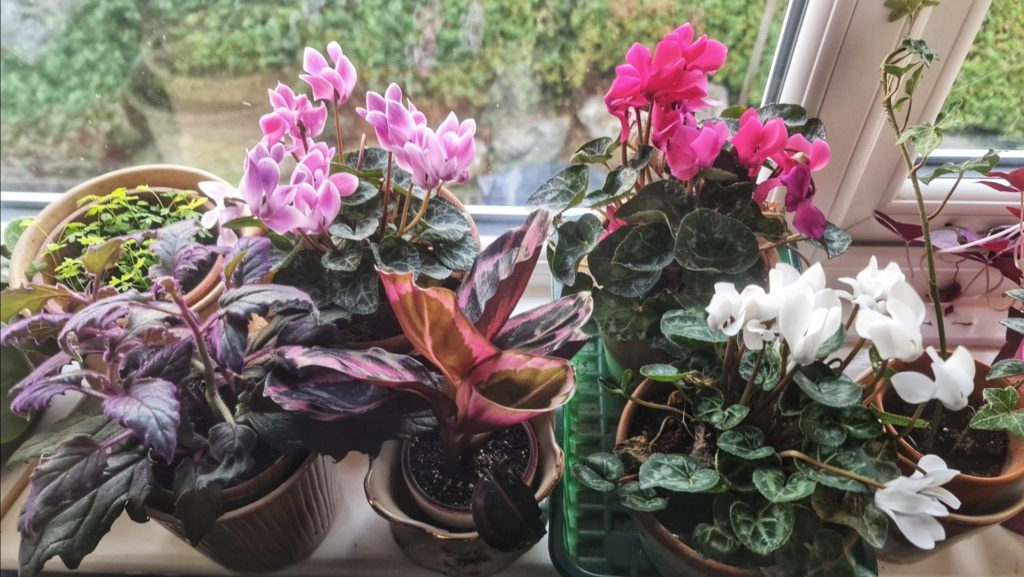
But I didn’t have just one Cyclamen. I had 5. I had the one my parents bought before I was born and which had lived with me all my life. I had the offspring of that same plant from when we split it about 5 years ago. I have a white one I bought before Christmas 2025 from a local garden centre, along with a purple one, and a pink variegated one.
Each one has a different lived reality. One has been a lifelong companion, the other is a child of that lifelong companion. The others are not so emotionally rich, but they make me feel different things all the same. The white one is pure and angelic; the purple one is deep and elegant, and the pink variegated one is striking and bold. The botanical truth is that these are all the ‘same’ plant, but my life tells me otherwise. I don’t experience them as the same plant, like I don’t experience two homosapiens as the same people.
My system can’t record this. I can’t have one note for Cyclamen that records, in “Status” metadata, the life story of 5 very different plants.
The War Between Two Realities:
The conflict arises out of the fact both realities are true, but the pages could not give equal weight to them. It was trying to perform the role of being both a reference and a diary at once, but it’s almost a necessity of data that the objective truth wins out.
But when I move through my own life, the botanical truth is of far lesser importance to me, emotionally. What I want to record, really, is my relationship with my plants. I don’t buy them because they’re Cyclamen, or Narcissus, or Oxalis, or Lobelia, etc. I buy them because I love their colour, or their structure, or their symbolism, or just how they make me feel when I look at them.
The system I built erased this. The real world data was messy and emotional and could not fit into a small metadata box. Of course, I can easily enough record that it is dead or alive (but not five times for five plants, in the metadata for one note), but how can I condense 25 years of companionship into metadata?
I have talked to that old Cyclamen. I have cried and dreamed by it for two decades. I have slept with it above me on the windowsill nearly every night of my entire life. I have forgot to water it more times than I can count and been genuinely distressed to see it wilting over the sides of its bowl. I have smiled from ear to ear at the glorious display of flowers every year, and been heartened by its vibrant beauty at a time of year where nearly every other plant is dying. It isn’t just a Cyclamen to me. Cyclamen is how I tell you what it is, and how I tell Google what it is. But to me, it’s been a companion. It’s a part of my life.
How Data Erases Us:
I have used my plants as an example, but I am not really talking about plants. I’m talking about a real threat that data poses to experience, and I think this is especially sharp, and painful, when taken in the context of how authorities record us, as people. When we lament that we are just a number on a bankroll at our jobs, or an ID number to the government, what we are expressing deep down is the same tragedy I outlined above. The document records you as being 5″11, 25 years old, as having a driving licence, a right to vote, an income, a tax number, and so on. But it doesn’t record the things you dream of, or what gnaws at your conscience at night. No record is made of your love, nor of your loneliness.
When I look at official documents about me, I never recognise myself, and it always makes me so sad.
Even if the records made some effort to capture our humanity they still couldn’t honour it. A document that records that you loved does no service to your love. Nowhere in that metadata is the truth of your life captured, for what of how you love? Where does the system hold a space for this?
There is no record still of the way you kiss your lover before bed; they way you rejoiced at the birth of your child; the way you mourned the death of your beloved dog. Nor of that time you danced under starlight with a childhood sweetheart, or that time you rushed a dear friend to hospital terrified you were going to lose him. Nothing you ever did to show your love is held in that system. It records the fact that you loved despite still knowing nothing about you, and even in its record you suffer the indignity of erasure.
How I Honoured My Life With My Plants:
It remains necessary to record emotionally cold data about things. In some way it is the only way we can understand the world correctly. True, and meaningful, though my private emotions are towards my plants, they do not practically help me to care for it. If I only had the knowledge that I had owned a Cyclamen for 25 years and I loved it, but no knowledge that it needed water and light, it would soon die. In some way maybe there is a causal link between data and reality: it must inform decision-making, to some degree, but it can’t be the whole record we keep of a thing we purport to care about.
I kept the old system, and removed any part of it that asked for information that served a different purpose. These authoritative notes were for botanical data only: the stuff that I need to know in order to take care of a plant.
I honoured my lived reality with them by giving that its own, distinct authoritative space. It does not compete with the botanical information. The page for my 25 year old pink Cyclamen contains no details on habitats, or care, or anything scientific. It records my experience with the plant.
Find Some Way To Express Yourself or Systems Will Erase You:
I conclude this, in some sense, where I started this whole website. And that is with the idea that you must find some way to express yourself, or you will be erased by systems. I write here because a part of me feels I have to; sometimes to explore something, sometimes to declare something, sometimes to share something, and sometimes to preserve something. Ephemeral Dawn is one of the records I make of my life. The government can’t tell you what I write on these sacred pages; nor my employer. They record data that is necessary, but if their word is the last word over my life, my existence will have been erased.
I don’t exist because their records say I do. I exist because my records show I do. Their data records necessary details for ensuring interactions with me are completed: taxation, payment, voting, and whatever else. But it is only my records that record my life. The truth is not in their work, but mine. I am not entry #1982920129. I’m a human being, in all the splendid glory, and painful complexity, and damnable imperfection that entails.
My life is lived here, not there. It’s an existence of many colours; a tune made of many notes; a painting of many brush strokes. It’s something progressive and evolutionary. It is not something fixed, printed in two-tone black and white, sat static in a file.
That cyclamen doesn’t exist in that database at all. It’s sat on my window, where it has been for years, growing, living, and flowering. All its beauty is there, in what can be experienced. I am there, too, with it.
Find some way to express yourself, dear reader, or systems will erase you.
Wishing you fair winds and a following sea,
Ephemeral Dawn.
I would love for Ephemeral Dawn to become not just a publication, but a community; a way for hearts and minds that feel and think in the same spirit to communicate, and share ideas. Please, don’t be shy about commenting. I would love to hear from you.
To try and manage spam, comments are moderated: everyone’s first comment needs manual review but after that the same user can post unrestricted. The only hard rule is no links are allowed, because that’s the most reliable way at the moment I can automate binning spam comments.